Found a copperhead by the steps, in the pine straw or in the garage? For most sightings the first move is the same: leave it alone and give it plenty of space, which is the advice of the North Carolina Wildlife Resources Commission (NC Wildlife). Left alone, a copperhead will almost certainly move on within a few minutes or hours, according to an NC State Extension agent. Call for copperhead removal when it gets into the house, the garage or the crawl space, or will not leave a spot your family has to use.
If it is in a room of your house right now, keep everyone out of that room and call. The line is answered 24/7, so you can call the moment you find it, even at night.
Found a Copperhead in Your Yard? What to Do Now
Here is what to do if you find a copperhead in your yard, in order:
- Stop and back away. Give it plenty of space. You do not need to get closer to be sure what it is.
- Bring kids and dogs inside. Keep them in until the snake has moved on.
- Do not try to catch or kill it. NC Wildlife says a large percentage of copperhead bites happen when people try to capture, kill or handle them.
- Use a hose if it is in the way. On a doorstep or driveway, NC Wildlife suggests spraying it with a garden hose so it moves along while you stay at a safe distance.
- Give it time. On a cool day, NC Wildlife says, a snake may not yet have the energy to move away and may need longer before it leaves.
- Watch where it goes. From where you are standing, note where it went, so you can say exactly where to look if you call.
Indoors is a different situation: shut the door to that room if you can do it safely, keep everyone out and call. Our page on what to do about a snake in the house covers the minutes until help arrives.
When to Call for Copperhead Removal
Most copperheads in a yard need nothing more than distance and time. A call for copperhead snake removal makes sense when the snake:
- is inside the house, garage, shed or crawl space
- has settled under a deck, porch or step that people use every day
- is resting in a bed or pile beside a door or play area, where a child's hand or foot could land near it
- keeps turning up in the same spot by the house after you have seen it leave
NC Wildlife does not send anyone out to remove snakes, so this is work for a private company, and our Mooresville Snake Removal page explains how a call works. Before you book, ask what the visit includes and where the snake will be released. NC State Extension says a snake taken out of a building should be released on the same property, because moving snakes long distances raises their risk of dying.
If you think there is a den under the house or inside a pile of debris, do not dig into it or reach under the floor; leave copperhead den removal to the company you call. NC State Extension's rule is to never try to move a venomous snake yourself, whatever you are wearing.
How to Get Rid of Copperheads
If you want to know how to keep copperheads out of your yard for good, the honest answer from an NC State Extension agent is that there is probably no practical and effective way to do it. The same agent warns that trying to kill or move one may increase your risk of being bitten. What you can change is how welcome a copperhead feels next to the house, and how easily anything gets inside it.
What Attracts Copperheads to Your Yard
Shelter comes first. NC State Extension says copperheads can be located under cover objects, and its snake guide names downed wood, pots, rocks and other debris as the hiding spots snakes are drawn to. Food sources are the other pull. What do copperhead snakes eat? Amphibians, reptiles, birds, small mammals and large insects, according to NC State Extension's page on copperheads and other vipers, so a damp corner full of frogs or a shed with mice gives one a reason to stay.
How to Keep Copperheads Away From the House
Copperhead control around a house starts with the ground beside the doors, steps and walkways your family uses every day, because that is where a copperhead resting under cover is most likely to end up near a hand or foot. Boards, pots and debris in that strip are the first things to move. If one has turned up inside the garage or crawl space, the gaps it used matter more than the yard; our page on snake exclusion explains how those openings are sealed.
Skip the repellents, including anything sold as a copperhead deterrent. NC State Extension says they have not been scientifically shown to work and can be harmful to people and pets if not used properly. For the rest of the yard, our guide on how to keep snakes away has the full plan.
What Does a Copperhead Look Like?
From a safe distance, look for these features, all from NC Wildlife's description of adults:
- Hourglass bands: chestnut brown crossbands, narrow across the middle of the back and wide on the sides.
- Base color: a light brown, coppery or tan body, sometimes leaning grayish or pinkish.
- Head: tan or copper with no pattern on top and a thin dark line from the eye to the rear of the jaw.
- Size: an average adult is 2 to 3 feet long, and NC State Extension says they can reach 48 inches.
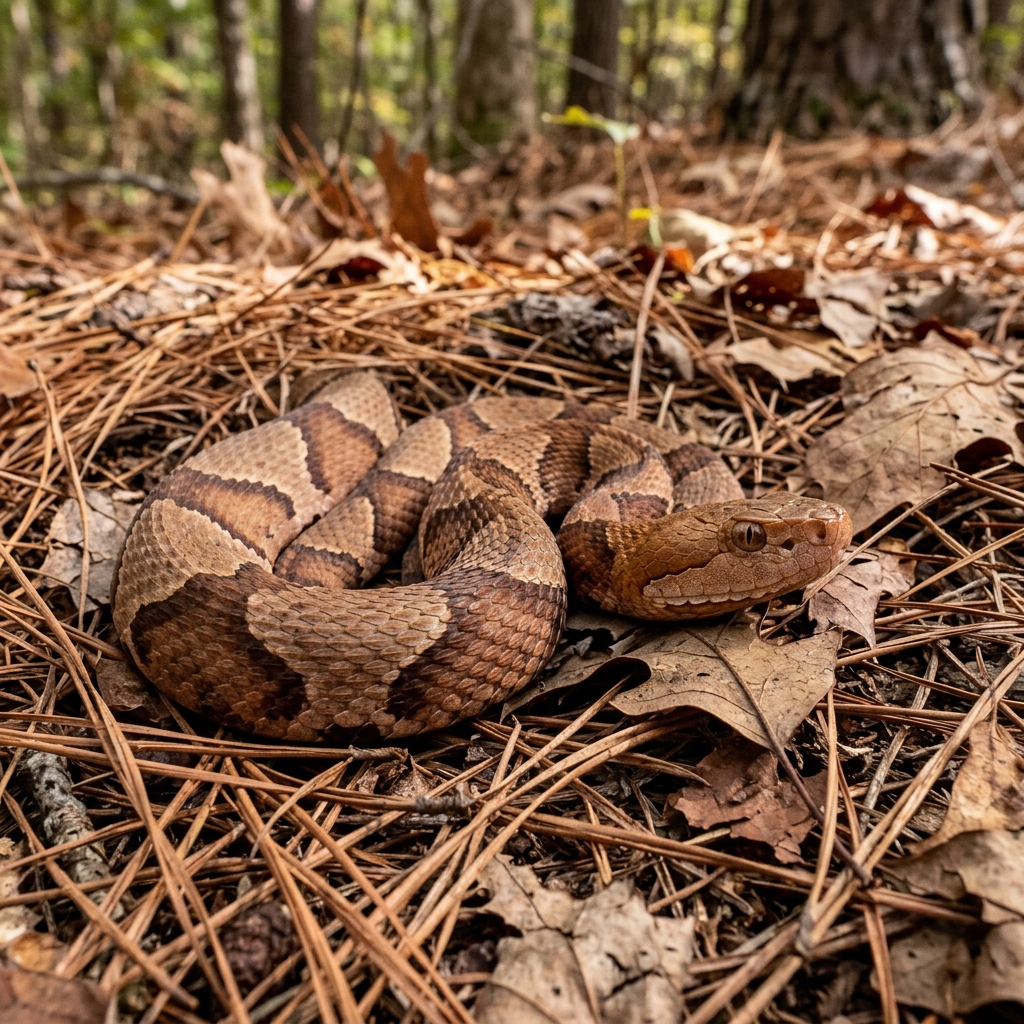
NC Wildlife also lists vertical pupils and a heat-sensing pit between the eye and nostril. Those are close-up details, so never get near enough to check them. Head shape proves little either: NC State Extension notes that some harmless snakes flatten their heads and flare their jaws outward.
Tip: if you cannot tell from where you stand, treat it as a copperhead. NC State Extension says not to handle a snake when you are unsure of the species or suspect it is venomous.
A small banded snake with a yellow tail tip, and the harmless snakes often taken for one, are covered in our baby copperhead guide.
Are Copperheads Aggressive?
No. NC State Extension describes copperheads as not aggressive: when they meet a person they usually try to escape, and they may bite if they are stepped on, cornered or restrained. NC Wildlife adds that snakes in this state bite people only to defend themselves, and that copperheads often give a dry bite with no venom.
So how do bites happen? NC Wildlife says many come from carelessly placing a hand or foot too close to a copperhead that is resting. The other big cause, trying to kill or handle one, is in the steps above. Here is how to avoid copperheads day to day: look before you reach into pine straw, leaf litter or woodpiles, and watch where you step along beds and paths.
Copperhead Bite: What to Do
Get medical care right away. That one step comes first in what to do if bitten by a copperhead: NC State Extension says to seek medical attention immediately after any venomous snake bite, and NC Wildlife says a copperhead bite is painful and should be treated as serious, even though it is not considered life threatening.
Do not chase the snake or try to catch it to bring along. If you can, note its color and where it was from where you are standing.
Copperheads account for probably over 90 percent of venomous snakebites in North Carolina, according to NC Wildlife. A dog that has been bitten needs a vet just as fast, so call the vet on the way.
Copperheads in North Carolina
Where do copperhead snakes live? Nearly everywhere in this state: NC Wildlife lists the copperhead as the most common and widespread venomous snake in North Carolina, and NC State Extension says it occurs everywhere except the Outer Banks. In many areas, including most of the larger urban areas, NC Wildlife says the copperhead is the only venomous snake. Most of the state's 38 snake species are harmless to people.
Mooresville sits well inside that range, from wooded lots inland to the shoreline around the lake. Our page on Mooresville neighborhoods groups local communities by setting, and our guide to Lake Norman snakes covers the water snakes people meet at the lake. For every species in the state, see snakes in North Carolina.
The young are born in late summer or early fall; our guide covers baby copperhead season. NC Wildlife lists pilot, chunkhead, poplar leaf and highland moccasin among the local names.
Copperhead at Your House?
Call (844) 595-3326 any time, day or night, if it is inside or will not leave. For anything that can wait, such as repeated sightings, the form works too.
Copperhead Removal Questions
Can a copperhead kill you?
Rarely. NC State Extension says copperhead venom is rarely fatal, and NC Wildlife says a bite is not considered life threatening. A bite is still painful and needs medical care right away, so treat it as an emergency.
Can a copperhead kill a dog?
A bite to a dog can be serious, so treat it as an emergency and call your vet right away; the vet is the one who can judge how bad it is. To prevent one, keep dogs inside or on a leash until a copperhead you have seen moves on.
Should I kill a copperhead in my yard?
No. NC Wildlife says a large percentage of copperhead bites happen when people try to capture, kill or handle them, and it lists the copperhead as a nongame species. Leave it alone, hose it off the doorstep if it is in the way, or call for removal if it will not leave.
Will a copperhead leave on its own?
Usually, yes. An NC State Extension agent says a copperhead left alone will almost certainly leave within a few minutes or hours, and NC Wildlife's advice is the same: give it time and space. In cool weather it can take longer.
Are copperheads poisonous?
Venomous is the accurate word, and it is the one NC Wildlife uses. Many bites carry no venom at all: NC Wildlife says copperheads often give a dry bite when they bite in self-defense.
When are copperheads most active?
Day or night. NC State Extension says copperheads can be active at either time, so an early morning or after-dark sighting by the steps is nothing unusual. Watch where you step on paths and stairs after dark as much as in daylight.